
Personalized compounding trusted by healthcare professionals
SmartPharmaRX compounds medications to support patient-specific treatment needs. Each therapy is prepared according to provider direction and follows rigorous quality, preparation, and verification standards.
Featured therapies
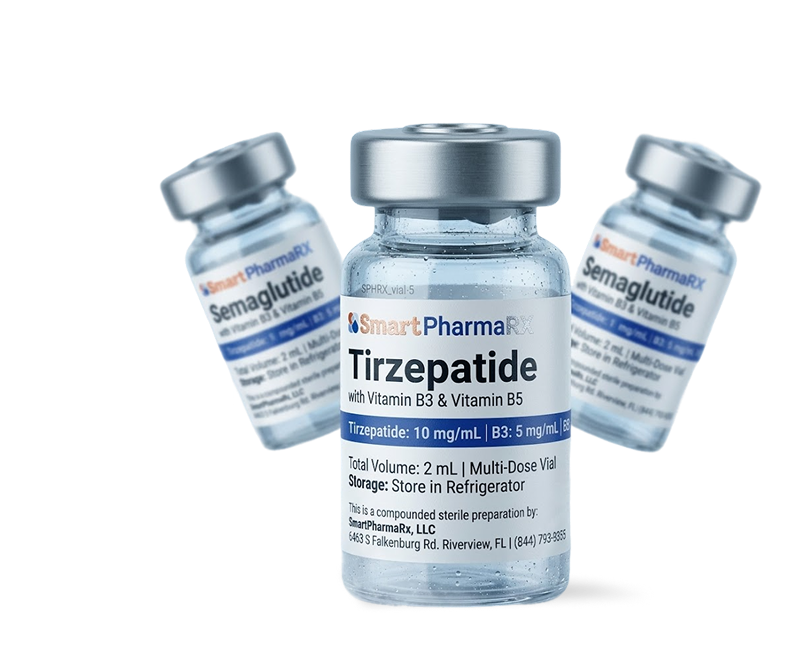
SmartPharmaRX currently compounds GLP-1 medications commonly prescribed for metabolic and weight management care, based on provider direction and clinical requirements. Explore our offerings below
Tirzepatide
Overview
Tirzepatide is a GLP-1–based injectable therapy that may be prescribed as part of a personalized treatment plan. Compounded formulations are prepared to support patient-specific dosing and continuity of care while following defined quality and preparation processes.
More details
Key ingredients
Tirzepatide (GLP-1–based active pharmaceutical ingredient)
Formulation & dosing
- Compounded according to provider-specified concentrations
- Prepared for individualized dosing based on clinical direction
- Intended for injectable administration as prescribed by a licensed provider
Quality & Preparation
- Prepared in controlled, sterile environments
- Active ingredients sourced from licensed suppliers and reviewed for purity
- Formulations follow defined compounding and verification processes
Important considerations
- Tirzepatide is available by prescription only
- Use is determined by a licensed healthcare provider based on individual patient needs
- Patients should discuss potential risks, benefits, and side effects with their provider
Side effects (general)
Some patients prescribed GLP-1–based therapies may experience gastrointestinal effects such as nausea, vomiting, or diarrhea. Side effects vary by individual and should be reviewed with a healthcare provider.
Important Risk Information
Material Risks: Tirzepatide is associated with a risk of thyroid C-cell tumors, including medullary thyroid carcinoma (MTC), based on animal studies. Relevance to humans is unknown. Report any neck mass, difficulty swallowing, hoarseness, or shortness of breath to your provider immediately.
Contraindications: Do not use if you have a personal or family history of medullary thyroid carcinoma (MTC) or Multiple Endocrine Neoplasia syndrome type 2 (MEN 2). Not for use in patients with a known hypersensitivity to tirzepatide or any of its excipients.
Common Adverse Reactions: Nausea, diarrhea, decreased appetite, vomiting, constipation, dyspepsia, abdominal pain, and injection-site reactions.
Serious Adverse Reactions: Pancreatitis, hypoglycemia (especially with concurrent insulin or sulfonylurea), acute kidney injury, hypersensitivity reactions (including anaphylaxis and angioedema), diabetic retinopathy complications, increased heart rate, and suicidal behavior or ideation.
Always consult your prescribing provider before starting, adjusting, or stopping this therapy. This information does not replace professional medical advice.
Semaglutide
Overview
Semaglutide is a GLP-1–based injectable therapy that may be prescribed as part of a personalized treatment plan. Compounded formulations are prepared to support patient-specific dosing and continuity of care while following defined quality and preparation processes.
More details
Key ingredients
Semaglutide (GLP-1–based active pharmaceutical ingredient)
Formulation & dosing
- Compounded according to provider-specified concentrations
- Prepared for individualized dosing based on clinical direction
- Intended for injectable administration as prescribed by a licensed provider
Quality & Preparation
- Prepared in controlled, sterile environments
- Active ingredients sourced from licensed suppliers and reviewed for purity
- Formulations follow defined compounding and verification processes
Important considerations
- Semaglutide is available by prescription only
- Use is determined by a licensed healthcare provider based on individual patient needs
- Patients should discuss potential risks, benefits, and side effects with their provider
Side effects (general)
Some patients prescribed GLP-1–based therapies may experience gastrointestinal effects such as nausea, vomiting, or diarrhea. Side effects vary by individual and should be reviewed with a healthcare provider.
Important Risk Information
Material Risks: Semaglutide is associated with a risk of thyroid C-cell tumors, including medullary thyroid carcinoma (MTC), based on animal studies. Relevance to humans is unknown. Report any neck mass, difficulty swallowing, hoarseness, or shortness of breath to your provider immediately.
Contraindications: Do not use if you have a personal or family history of medullary thyroid carcinoma (MTC) or Multiple Endocrine Neoplasia syndrome type 2 (MEN 2). Not for use in patients with a known hypersensitivity to semaglutide or any of its excipients.
Common Adverse Reactions: Nausea, diarrhea, decreased appetite, vomiting, constipation, abdominal pain or discomfort, and injection-site reactions.
Serious Adverse Reactions: Pancreatitis, hypoglycemia (especially with insulin or sulfonylurea), acute kidney injury, hypersensitivity reactions (including anaphylaxis and angioedema), diabetic retinopathy complications, increased heart rate, and suicidal behavior or ideation.
Always consult your prescribing provider before starting, adjusting, or stopping this therapy. This information does not replace professional medical advice.

Our commitment to excellence
We are committed to maintaining trusted partnerships with patients and partners. This commitment drives our disciplined approach to compounding that prioritizes precision, oversight, and accountability at every step of the process and ensures an operational scale without compromising safety.
Frequently asked questions
Find quick answers about prescriptions, delivery, and how SmartPharmaRX supports your treatment at every step.
What is a compounded medication?
Compounded medications are prescription preparations created by a licensed pharmacist to meet the specific needs of an individual patient when commercially available products are not appropriate or available.
Compounded medications are prepared pursuant to a valid patient-specific prescription and are not FDA-approved products.
Who can prescribe compounded medications?
Licensed health care providers with prescriptive authority may prescribe compounded medications for their patient in accordance with applicable state and federal regulations. Prescriptions must be issued by a provider acting within the scope of their professional license and scope of practice.
How do I place an order?
Prescriptions should be submitted through the provider’s electronic prescribing system (eRx) by selecting our pharmacy within the prescribing platform.
What information is required on the prescription?
- Prescriptions must include:
- Patient full name and date of birth
- Prescriber name, credentials, NPI number, and signature (when required)
- Medication or compounded formulation
- Strength and dosage form
- Directions for use
- Quantity to dispense.
- Number of refills (if applicable)
- Date written.
- Clinical rationale indicating why the patient requires a compounded preparation that cannot be met by a
- commercially available product.
- Patient allergies or relevant clinical information (when applicable)
Can you compound medications that are commercially available?
Under federal compounding regulations, pharmacies operating under Section 503A of the Federal Food, Drug, And Cosmetic Act generally compound medication only when there is a clinical need for a patient specific preparation that cannot be met by an FDA-approved product.
What quality and safety standards do you follow?
Out pharmacy compounds sterile preparations in accordance with USP <797> standards and applicable state board of pharmacy regulations.
Quality systems include:
- Environmental monitoring of sterile compounding areas
- Sterility and endotoxin testing when applicable
- Qualified cleanroom facilities
- Standardized compounding procedures
- Ongoing quality assurance and continuous quality improvement programs.
Are compounded medications FDA approved?
No. Compounded medications are not FDA approved products. They are prepared by licensed pharmacists in accordance with federal and state compounding regulations to meet the needs of individual patients.
What storage conditions are required for these medications?
Storage requirements vary depending on the formulation. Most sterile injectable preparations require refrigerated storage (typically 2°C to 8°C / 36°F to 46°F) unless otherwise specified on the prescription label. Providers and patients should follow the storage instructions provided with each medication.
How are medications shipped?
Medications are shipped using packaging designed to maintain product integrity during transit. Temperature-controlled packaging is used when required based on product storage conditions.
What if a prescription needs to be updated or corrected?
If a prescription requires clarification or changes, our pharmacy team will contact the prescriber’s office. Updated prescriptions may be submitted electronically or provided verbally to a licensed pharmacist, in accordance with applicable state regulations.
Can prescription be transferred from another pharmacy?
In most cases, prescriptions cannot be transferred to our pharmacy. Compounded medications are prepared based on specific formulations and requirements that may differ between pharmacies.
Additionally, prescriptions written for commercially available brand-name medications cannot be filled as compounded preparations unless the prescriber issues a new prescription specifying the compounded medication.
Providers who wish to have a prescription filled by our pharmacy should submit a new prescription directly to our pharmacy.
Can providers discuss formulation options with a pharmacist?
Yes. Our pharmacists are available to discuss formulation options, administration considerations, stability information, and other pharmacy-related questions to support patient care.
A trusted partner in personalized compounding
Partner with a pharmacy built to support precision and care in every prescription.